

There is some poetic justice in the fact that our current strain of techlash was prompted by a book.
Amid an attention crisis that is pushing reading rates ever lower, Jon Haidt’s The Anxious Generation has become a totem for parents and policymakers alike, and has now set off a domino effect of social media bans for children around the world.
Yet the author of that very book admitted earlier this year that he himself hardly reads these days.
“We adults, we’re all overwhelmed,” Haidt told the Hard Fork podcast in January. “I’m overwhelmed. I can’t read a book anymore. There’s too much other stuff coming in.”
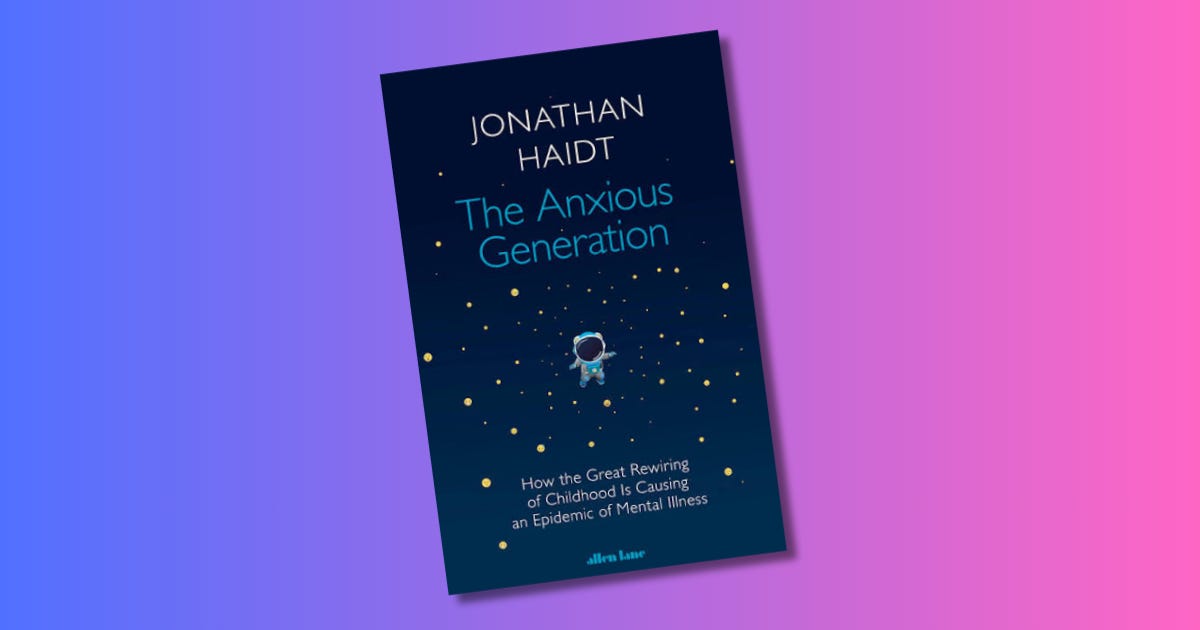
When Australia became the first nation to raise the ‘digital age of consent’ to 16 earlier this year, the policy had a clear lineage. Annabel West, the wife of South Australia Premier Peter Malinauskas, had urged him to act after reading Haidt’s bestseller.
The book makes a simple argument: that the rise of smartphones and social media usage among teens has been the primary culprit for plummeting mental health. It makes four core recommendations: no smartphones before high school (age 14), no social media before 16, phone-free schools, and more independence and responsibility in the real world.
Following Australia’s lead, Britain is now planning to introduce a ban on social media for under-16s. Several questions remain on how it will work, but with cross-party support, it seems likely to face little opposition on its way into law.
Dozens of other countries are also barrelling towards much tighter restrictions on social media for children. Haidt’s influence in all of this is well-documented. In January, leadership hopeful Wes Streeting invited him to address an event and the two then also met in February. The former health secretary later proclaimed that social media should be treated like tobacco.
Haidt has also lent his support to British grassroots parent groups like Smartphone Free Childhood and he has submitted evidence to the House of Commons.
The author’s willingness to segue from researcher to activist has helped, but still: it seems fair to say that The Anxious Generation may well be the most influential book on government policies since the 1960s, when titles like Silent Spring and Unsafe at Any Speed could effect huge shifts in politics and public opinion.
Of course, part of why the book was so successful in the first place was that it gave readers data to understand something they had already observed.
As I have argued before, the ban reflects a desire to fix several things we think have gone wrong in the past decade or more with society as a whole, not just children. Adults, including Haidt himself, have lost control of our relationships with digital products. Streeting, too, said his concentration span has suffered due to doom-scrolling. We do not know how to get back on top of our phone habits, so we are trying to hit the reset button on under-16s1.
Grown-ups having experience of the problem first-hand, Haidt acknowledged on that same podcast interview, is part of “why we’re winning” and why it’s “so easy to get laws to protect kids all over the world”.
So are we doing this because it’s going to work, or because it’s easy?
Part of the problem is that we haven’t precisely defined what it would mean for the ban to “work”.
On Monday, the Prime Minister took to Substack to explain the thinking behind the new policy.

He identified all the greatest hits of concerns about social media: time lost to scrolling, cyberbullying by peers, messages from strangers, the impact on mental health.
Will the new rules tackle all of these? As many have pointed out, the exemptions from the ban, such as Whatsapp, mean it likely won’t put a stop to cyberbullying. As for the disruptive effect on attention, one can easily swap scrolling for gaming.
Politicians like the idea of a social media ban because, like screening Adolescence in schools, it looks dramatic and decisive, without proof that it is going to work. Even worse, there is a possibility that rules like these come in without a clear idea of how we are going to measure whether they are effective.
Haidt himself began by focusing on the mental health of adolescents. But by becoming involved in advocacy, he too has come to see social media as a shibboleth for all kinds of ills.
On Hard Fork, Haidt pre-emptively shifted the goalposts for scoring the success of Australia’s ban.
“This whole debate has been framed around mental health. And if it doesn’t improve mental health, does that mean we should undo it? I would say no. I would say: Tell me how many kids have been sextorted. Tell me how many kids have died from drug overdose deaths. Let’s look at all the other ancillary harms, and then we can decide whether it was a good policy.”
Despite this, I think Haidt has a clearer view on this topic than many of those inspired by him. When I read The Anxious Generation and found myself more convinced than I had been that things could not go on like this.
But I was also surprised by how little I hear the rest of his argument discussed. It makes me wonder how many people have read the whole book – or whether they are only remembering the bits they want to hear.
Going back to the four pillars recommended in The Anxious Generation, the focus has been on the rules-based actions such as keeping phones out of schools and keeping children off social media, with very little about encouraging more independence and free play. This is not just a social norms issue – Haidt points to many cases of parents facing legal consequences for attempting to allow their child to do something without supervision.
Haidt is quite clear that children and teenagers need risk and discomfort, as well as a sense of autonomy, in order to develop. Removing online risks without allowing a corresponding increase in independence offline is only going halfway to a solution. Taking away phones has to be coupled with allowing kids to do something else. What is the vision for how to create those alternatives?
Whether you accept Haidt’s thesis or not – and there are plenty of critiques out there of his methodology – I’d recommend reading the book. It’s worth understanding the argument in its entirety. Even if you want only to argue against it more effectively.
Teatime scroll Each week I share links to writings, events, tweets and other conversation-starters. If you have something you think should be in here, feel free to email or DM me.
🍴Speaking of Hard Fork, co-hosts Kevin Roose and Casey Newton have announced they are leaving The New York Times to go it alone and launch their own podcast. I’m excited to see where this goes – there’s a Substack to subscribe to here if you want to see updates.
🔒 I didn’t get into all the implications for online privacy in this piece, but Lucy HM has a great write-up on Project Glitch.
📍As I wrote about last month, the augmented planning tools made by Google and Faculty are now being tested across several councils. In a blog post, Faculty confirmed it would be rolled out nationally from 2027.
🦋 For The New Statesman, I wrote about what the Fable 5 and Mythos 5 restrictions mean for Britain.
✍️ We had a great time at the Founder-Writer Collective on Tuesday! Kirsty Cooke wrote a round-up of some of her favourite takeaways. I won’t be around for the next one but Eleanor is hard at work arranging it. Follow the calendar and stay tuned for updates.
This despite Streeting (42) and Haidt (62) both being too old to have become hooked as children, which suggests that abstaining into adulthood doesn’t make one immune to falling into attention traps later on.