

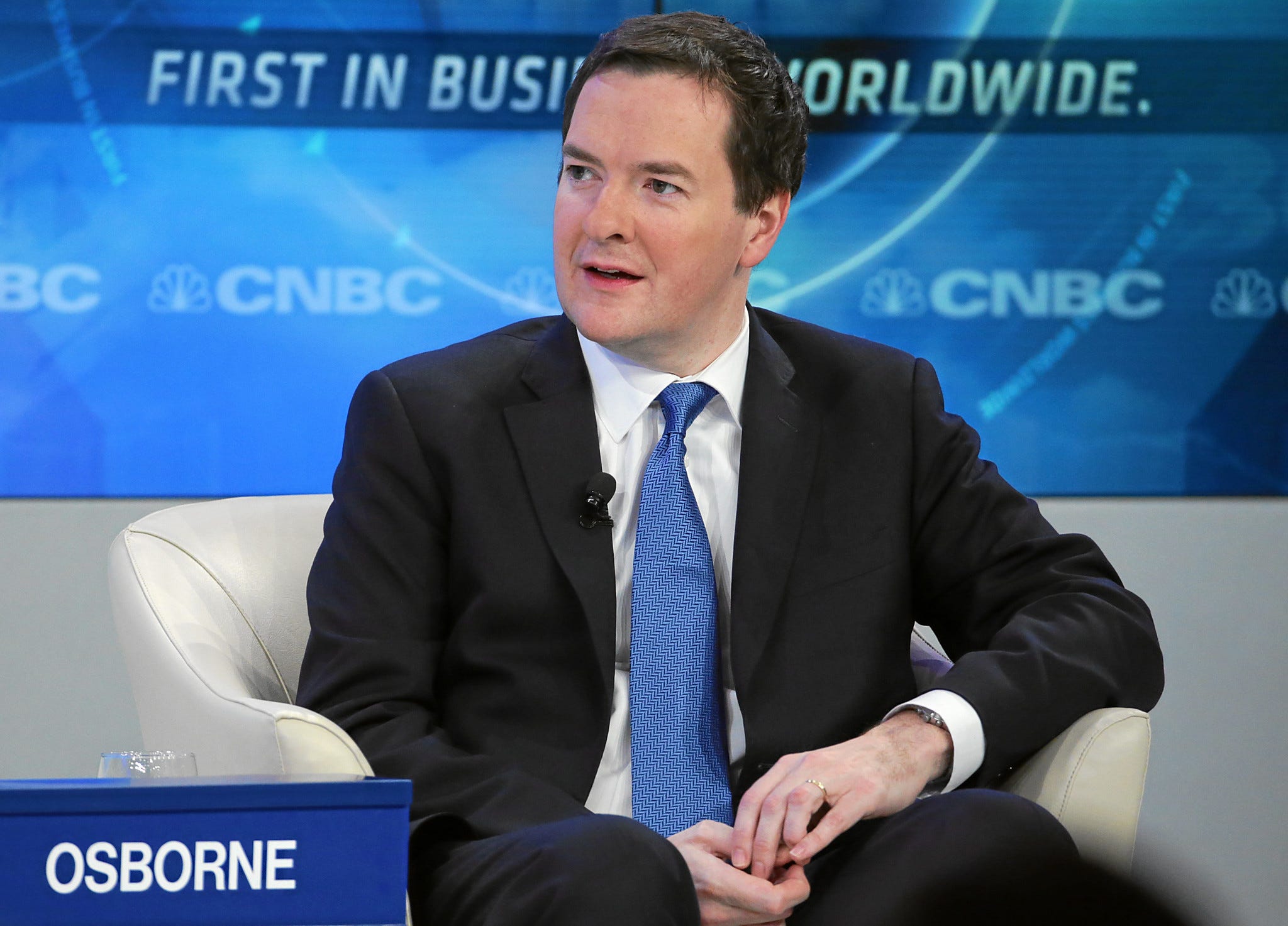
Former chancellor George Osborne said in a tweet on Tuesday night that he is joining OpenAI to lead its OpenAI for Countries initiative.
“I recently asked myself the question: what’s the most exciting and promising company in the world right now? The answer I believe is OpenAI.”
Truly, a feat of manifestation from the Six Dinner Sid of prestigious positions. Osborne being a not exactly uncontroversial character in British politics, the reactions to this news were swift and sceptical.
“This is SO bearish,” declared Dario Perkins, a macroeconomist who worked (briefly) at the Treasury during Osborne’s tenure. He was one of several who pronounced it a bad sign for OpenAI, or indeed for AI in general.
Others also pointed to Osborne’s record in power, something that comes up every time he snags a new role. “The most power hungry company with ambitions to automate the entire global workforce, hires the man that has probably done the most damage to the UK economy over the last 2 decades through his ill conceived and poorly implemented fiscal policies as Chancellor,” was the conclusion that LFG co-founder and another ex-Treasury bod (though too late to have crossed over with Osborne) James Newport sent me via DM.
Some combined the two critiques. “I was looking for a signal that we had reached peak AI and now we have it,” commented the economist Albert Edwards. “After George Osborne wrecked the UK economy as Finance Minister, his (absurd) move into AI surely marks its imminent death knell. It was fun while it lasted.”
Of course, the obvious comparison is to Nick Clegg, who headed up Meta’s global affairs for almost seven years. Was that tenure a success? It was certainly financially prudent on his part. He made $19m in share sales and he still holds a substantial tranche of stock. We don’t know the details of Osborne’s compensation yet but I highly doubt he’d be joining ahead of one of the most anticipated IPOs in history without some equity on the table.
To me, if there’s anything that can be read into this appointment, it has little to do with Osborne himself and a lot to do with where OpenAI is heading.
The IPO is an important part of that. Current predictions put the company on track to go public in the latter half of next year, or maybe in 2027.
Adding an elder statesman (or at least a sprightly 54-year-old one) to the leadership team is exactly the type of thing a company might do as it prepares for the scrutiny of public markets.
Readying for an IPO is also a good reason why you might want to prove you have plenty of business prospects still to develop.
A tidy debut on the stock market will be all very well for OpenAI’s existing shareholders, who stand to make a killing if the reported goal of a $1trn valuation is accurate. But to be of any appeal to new money, be they savvy retail investors or investment bankers, there has to be some path to growth. Building a pipeline of massive infrastructure projects, backed by government funding, is a nice way to do that.
To understand Osborne’s move better, I think we need to take a closer look at OpenAI for Countries. The initiative is part of the company’s Stargate programme for building data centre capacity, a collaboration between OpenAI and SoftBank, with participation from a who’s who of other tech hyperscalers.
In an announcement made in May this year, OpenAI said that it had heard from several countries looking to build out their AI infrastructure, following the first deal that was struck with the US.
So far, so straightforward. Countries – like the UK, which has already signed its own deal for a Stargate site – want to build out their own AI capacity. But they need help to do it, and OpenAI for Countries is happy to lend a hand.
Where it gets a little more interesting is in a document available on OpenAI’s website, that was added to the initial announcement. It sets out the security approach of OpenAI for Countries, stating that the project is guided by three main aims:
(1) Extend and maintain our technology leadership
(2) Build a broad international coalition to promote U.S.-built democratic AI
(3) Maintain the world’s most advanced AI infrastructure in America
This positions OpenAI for Countries explicitly as an opportunity for American leadership on AI. By doing so, the company argues, it can “provide a clear alternative to authoritarian versions of AI that would deploy it to consolidate power”.
A sensible approach if you’re concerned about China’s AI maneuvers. It also fits with the current slant of technology companies, which I wrote about a few months ago, to be a little bit more openly patriotic. It’s the Palantir playbook.
On the other hand, you can see how the initiative could be read as an exercise in US soft power. At a time when many nations looking for this kind of AI infrastructure are talking about their own sovereignty, that’s not the impression one wants to give.
In that context, getting a non-American statesman on board to advance the project, and letting him run it from London, provides a counterbalance. Osborne can act as a toned-down messenger to nations that might otherwise be put off by the vibes of Stargate. At the project’s launch back in January, Trump said of AI, “what we want to do is we want to keep it in this country”.
Instead of the flags and eagles display of that event, world leaders will now be wooed a vintage British politician with a podcast, offering simply to be of help.
Chris Lehane, OpenAI’s chief global affairs officer (I guess that makes him, not Osborne, the Nick Clegg of OpenAI), went into more detail in a LinkedIn post welcoming the former Chancellor.
“I believe we’re in a Bretton Woods-style inflection point when it comes to AI,” he wrote, comparing the present moment to the 1944 conference between nations that led to the creation of the IMF. AI rails should, he said, be built on “openness, the rule of law, and the empowerment of people”.
“George is the ideal person to lead the next phase of that critical mission,” he added.
As for why Osborne in particular is suited to the role, it’s true that he wouldn’t be the obvious choice if the purpose was simply to lobby the British government. But this is an international role, one that will combine diplomacy with deal-making. An OpenAI spokesperson told me in a statement that the initiative “has become a central pillar of how OpenAI works with countries around the world on long-term AI strategy, infrastructure, and adoption – both in terms of government engagement and from a business perspective”.
Osborne has spent a significant chunk of the last few years overseeing deals as a partner at advisory firm Robey Warshaw, now part of Evercore. His first assignment, the spokesperson confirmed to me, will be heading to Davos – something he’s done many times before – to take part in OpenAI’s event at the conference.
All in all, this is the sign of a maturing firm. There’s even a question of whether hires like this will shift OpenAI’s culture. Per this blogpost by Calvin French-Owen1, a former member of technical staff at OpenAI, the company has a meritocratic, bottoms-up culture that helps great talent rise to the top, even if they need a bit of help mastering leadership skills along the way.
“Many leaders who were incredibly competent weren’t very good at things like presenting at all-hands or political maneuvering,” he writes. “That matters less at OpenAI then it might at other companies.” Is there incentive to keep plugging away as an ideas-first, promising talent who could one day become leadership material, if directors of divisions are now being brought in from outside?
As for the UK, I don’t think this has any major significance. Osborne’s remit will include Britain’s Stargate, sure, but that’s already been agreed. The more important part of his role will be winning new business. If anything, it perhaps says something about the politicians we produce, who do – despite their detractors – keep bagging roles like this. Rishi Sunak also recently took a role advising Anthropic. Perhaps, when things get serious, everyone likes to have a British accent in the room.
Teatime scroll Each week I share links to writings, events, tweets and other conversation-starters. If you have something you think should be in here, feel free to email or DM me.
🫧 For some more background on today’s topic, here’s a clip of a recent Political Currency episode in which Osborne and Ed Balls debate whether there’s an AI bubble. Perhaps unsurprisingly, Osborne is more optimistic than his co-host.
🇬🇧 🇺🇸 Reports are swirling that the US-UK tech deal is floundering, though Number 10 says negotiations are still active.
👑 There’s just one day left to tell the Sovereign AI Unit what you need if you’re running an autonomous lab in their preliminary market engagement.
🏇 Over on The Progress Post, we’ve launched a new format for short thoughts and back-of-a-napkin ideas, called Post Haste. Read the first one here, about whether there’s any such thing as a free lunch.
🎨 The government has published the results of its consultation on AI and copyright. The numbers reinforce that any watering down of licensing rules is not popular with the creative industries.
🗄️ London and San Francisco-based AI patent-drafting startup Solve Intelligence has raised a $40m Series B and is hiring for a range of roles, including several in London.
🦿 Sign up to come to the robot dance party on 18 January in London, which is exactly what it sounds like.
🔋 London-based Fuse Energy is now valued at $5bn after a fresh investment.
Thank you to @bowtiedjconnor on X for bringing this piece to my attention