
Inventing fun
Scenes from London’s creative technology ecosystem

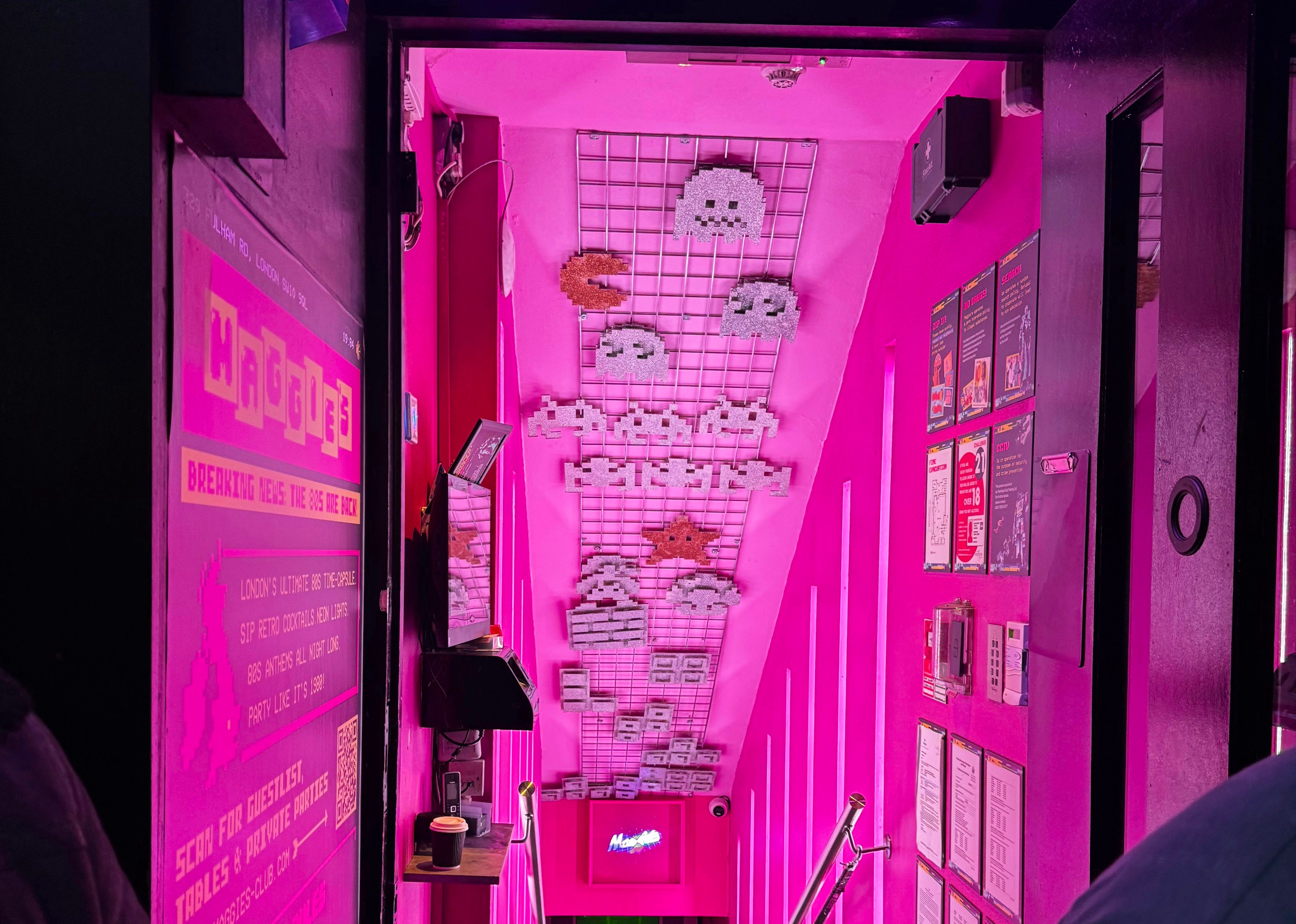
I hadn’t been to a nightclub in a really, really long time. So it was with some trepidation that I passed the velvet rope and descended the steps into a basement in Chelsea two Sundays ago.
Through a door made to look like an old-school gameboy, I found Maggie’s, a kitsch 1980s-themed venue where the walls feature photographs of Robocop and Margaret Thatcher.
Sat around the room were several teams, their laptops and other gadgets set up on tables made to look like giant Rubik’s cubes.
These were the people who had taken on the challenge of the robot rave hackathon, a collaboration between the Society for Technological Advancement (SoTA) and Cocoa Ventures. They had spent the whole weekend coding, testing and in some cases building their robots. Now it was time to dance.
The approaches were as varied as the participants themselves. Some teams programmed their robots to mirror facial expressions or track body movements, while others coded elaborate dance sequences or synced their machines to respond to the music’s rhythm.
There was some high-end kit on offer, including a Unitree Go1 robot dog and several robotic arms. But others went down a decidedly DIY route, cobbling their mechanoids together from cardboard and even Lego bricks.
The latter approach was taken by participant Alex and his son Daniel, whom he had brought along on day one hoping simply to show him a robodog and meet some cool people. “I never expected him to have the patience to work all day Saturday and continue through Sunday!” he said later in a note to the organisers. Their Lego creation earned them the Artistic Value prize.
Though many participants had highly technical backgrounds, nobody hesitated to employ AI coding tools like Claude Code to accelerate their work. Vibecoding seems to be lowering barriers, opening up hackathons to people who might previously have felt excluded, or simply redrawing the maths in terms of what it’s possible to achieve in a single weekend.
The atmosphere was equal parts focused and absurd. Watching hackers attempt to dance alongside their creations provided several moments of entertainment.
Naturally, there were also some mishaps: at one point, rolling lines of code on the big screen began a dramatic start-up sequence countdown. The crowd joined in, chanting “3... 2... 1...” Then nothing happened. The robot arm sat motionless. Such is the nature of the live demo.
SoTA’s hackathons often pursue goals that are serious, one could even say momentous. There have been events aiming to reboot state capacity or engineer the weather. The next one, a collaboration with ARIA to scale trust systems in the real world, is in the diary for next month.
That’s not to say those events aren’t fun. But there was opportunity for something different.
The technical challenges of the robot rave, though, were no less perplexing than other hackathons. It showed that hard problems can be solved in a way that also demonstrates appreciation for art, music and culture.
“We often say the best way to predict the future is to create it, and seeing SoTA’s community infuse life into complex quadrupeds, arms, humanoids and ground vehicles on the dance floor demonstrated techno-optimism grounded in creativity and capability,” SoTA director Jamie Croucher told me in an email after the event. “We’re looking forward to holding more events to cultivate optimism about technology as a creative pursuit.”
The robot rave was a special night. But it was not the only example of an event at which artistic creativity and technology can come together. If you’re interested in how aesthetics, culture and creativity intersect with tech right now in London, then it’s remarkably easy to find your people.
Last week alone you could have attended the robot rave on Sunday, a conversation about AI and taste on Tuesday (more on that in a moment), the Feeling of Computing meetup on Thursday and the Restless Egg artist-founder get-together on Friday.
There are other places where one can explore similar scenes, most notably New York. But London seems especially strong right now.
“London is the most diverse city in the world, from culture to food and everything in between,” says Cocoa Ventures founder Carmen Alfonso Rico, who co-organised the robot rave alongside SoTA’s Matvey Boguslavskiy. The British capital is a “paradise for curiosity and creativity” she adds.
I was at a dinner last night where we got onto the topic of the cultural differences between the Bay Area and London. Before anyone could lament too fiercely the ambition gap that is so often discussed as a feature of the UK, several people pointed out that there’s something to be said for being a multi-sector town. All too often in San Francisco, you can find yourself in a restaurant and realise everyone else there is also a tech worker. In London, they could be an actor, a lawyer, a civil servant, an advertising executive, a museum curator. A hyper-focus on tech can be useful, but it can also be suffocating.
Every generation thinks they invented fun. So we must be wary of treating our own era with too much reverence. A few months ago, Mozilla published a map of what it called the “post-naive internet era”. Apps, publishers, communities, websites, anything that constituted part of this so-called scene was on there.
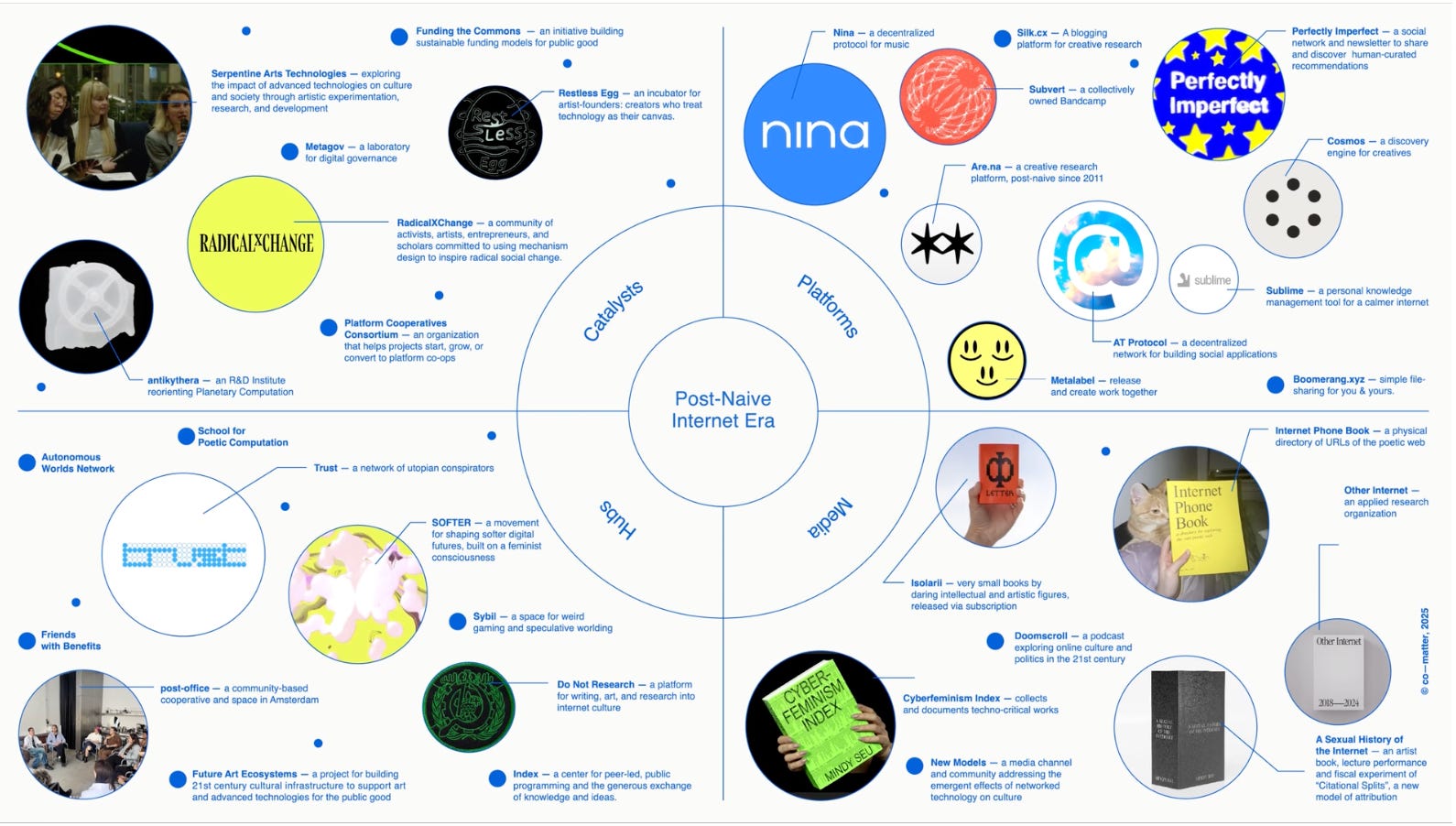
Restless Egg got a mention, as did the Serpentine Gallery’s Arts Technologies programme. But while it seemed to many like the graphic was identifying something new, the British artist Mat Dryhurst rst had a different take. “Always sobering to learn scenes you’ve been in for over a decade simply don’t exist for almost everyone else,” he commented.
Nevertheless, one could be forgiven for thinking that there is something special going on in the ecosystem right now. There are two reasons why I think this impression is so strong.
First, there is the AI boom, which has created new centres of gravity in London. Those include the UK offices of Google DeepMind and Anthropic, but also scale-ups like Synthesia and Elevenlabs, as well as hundreds of smaller startups. It simply means there are so many people here who have an interest in the creation of the future, and in thinking about things in ways that were inconceivable even a few years ago.

The second is that we are still experiencing something of a post-Covid renaissance in in-person events. It may seem a long time ago now, but the impact of lockdowns on offices, on where people live and on universities is still being unwound.
I would also give some credit here to Luma, a pandemic-era invention that has come to define post-lockdown events within certain sectors. Its pleasing interface and the fact that it still feels relatively curated makes it easier to find the right vibe.
Indeed, it was through that platform that I found out Frontier Tower, a San Francisco “vertical village for frontier-tech pioneers”, is planning to establish a second site in London. To start laying the groundwork, friends of the project are organising after hours salons, and the first of these was about taste in the age of AI.
On entering the industrial-chic apartment/workspace in Shoreditch, I felt like I’d been invited to the coolest house party in Brooklyn. The set-up was casual, and when it was time for the discussion element of the salon, we all grabbed whatever stool or cushion we could find and pulled them close to hear from the specialists: VideoStack.ai founder Aaron Jones, artist Rachy McEwan, and Bigged CMO Luke Nelmes.
What was interesting was how quickly the rest of the room weighed in. Opinions differed – not just on the definition of taste, but on how art and AI should or shouldn’t interact. It felt like an urgent discussion, and one in which this broader scene I’m trying to describe might play an important part.
After all, we cannot talk about art and technology without acknowledging that some consider the latter a threat to the former. Many artists are reflexively anti-AI. In turn, many technologists can be quick to dismiss the concerns of the traditional arts, or call them elitist. During the discussion, one person called out the tech sector’s overuse of the word “democratising” as a defence for AI-generated art; picking up a pencil and paper and trying to learn a skill is already about as democratic as it gets.
I think this friction is an important aspect to maintain as the creative technology scene develops. If artists and technologists cannot be in the same room together, there will never be any progress on these debates.
“It would be easy to think that with the rapid pace of AI, we are losing the precious qualities that made creation human: taste, design, emotion,” says Lachlan Chavasse, the founder of Daily and the organiser of the salon. “Yet when we gathered our community of those at the frontier of this change I was reassured. Those qualities weave themselves into stories. And when we treat these technologies as another tool, we can breach the silicon walls of generative media and return with a story worthy to be an artpiece.”
Teatime scroll Each week I share links to writings, events, tweets and other conversation-starters. If you have something you think should be in here, feel free to email or DM me.
🛰️ If you want to see more from SoTA, their next Frontiers night is on 18 February. You can also subscribe to their newsletter SoTA Letters for updates.
🖇️ The StartUp Coalition has launched a new initiative to directly connect startups with government buyers, called Pipeline.
🧬 Major cuts will hit UK science facilities and government research grants for physics and astronomy over the next four years, to the tune of a £162m reduction in spending, Frances Jones reports for Research Professional News.
📠 I enjoyed parts of Rebecca Solnit’s essay about what technology takes from us in today’s Guardian (and I think she’d approve that I actually read it in print). But I felt she fell into the trap of taking anything Cluely says seriously, when they are clearly engaging in what Sophia Epstein calls “dystopia bait”.
🇬🇧 You’ve never seen a job title as UK 2.0 as this: apply to be Head of Making Canva Feel British.
🌐 I’m working on a piece about the history of GOV.UK, in light of Anthropic signing on to be the AI partner for the service. If you’ve ever worked on GOV.UK or know anyone who has, please do get in touch.
Really does feel like something special is happening in London, and the multi-dimensionality of it is in my opinion so important for cultural diversity (vis-a-vis what you're saying about sf).
I really think now is the time for more permanent open-access spaces where people can build. This is common for artist studios, something I believe London does quite well. But we need to bridge this into spaces where people forge new ideas that spill over from these events. Frontier Tower will be a space for this, but we need many more places where artists and technologists can just hang out and invent fun!
Great chatting Alys - rather gutted I missed the SoTA Rave!!!