
Lessons from the fintech boom
ClearScore co-founder and CEO Justin Basini reflects on life in the 2010s

I have a bit of a taste for recent history. It’s fun to see how current events coagulate into distinct eras and longer-term narratives, even as they are still happening.
One benefit of looking back just a few years is that it allows us to better understand what’s new and what’s not about our own times.
Recently I went down to Vauxhall to visit the offices of ClearScore, one of the big success stories of the UK’s fintech boom. While several of the memorable names from that time – Monzo, Revolut, Starling – are challenger banks, Clearscore took different approach by providing credit scores and reports for users, for free. It has since grown to offer a range of services, and is estimated to be worth £1.5bn-£2.5bn if it were to IPO any time soon.
Co-founder and CEO Justin Basini set up the business in 2015. A serial entrepreneur, he had also spent time at Deutsche Bank and Capital One, so he was in a good position to join the burgeoning fintech community that began coalescing in London early last decade.
Just over ten years on, I wondered what he made of that period now, and what we could learn from it as London goes through a fresh season of tech hype, this time centred on the AI industry.
Froth and the financial crisis
We can’t start straight away with the 2010s, the Tory government, open banking, the christening of Silicon roundabout, and all that. A closer parallel to current times, in Basini’s telling, would be the dot-com era. In an interview on the How to Fail podcast with Elizabeth Day (to whom Basini is married), he spoke about the days of his first startup Differ, which he ran 2000-2001. His description of that atmosphere could easily be mistaken for one about today.
All of this money coming in, everybody was going to be a millionaire. It was really exciting. And in London, it was super amazing. You’d go to things every evening, talking with entrepreneurs and technologists about how the world was going to change and what was going to happen.
I bring this up in our conversation and ask if the 2010s felt similar. “It was different because of austerity,” he explains. “The country was going through a really difficult time. You had a new government. You’ve just been through the global financial crisis, and so actually, it was quite a down time. And lots and lots of people were struggling.”

The excitement both during the dot-com boom and now is at such a scale that it can lead to “froth”. The early 2010s, by contrast, were not very frothy. Nevertheless, in 2010 Basini quit his job at Capitol One and started a new company, called Allow.
Raising money for that business, between 2010 and 2013, “was a difficult time”
“I had to see 75 VCs before I got any money”.
Still, he wasn’t alone. GoCardless, co-founded by Monzo founder Tom Blomfield, got its start in 2011. Others were beginning to work on neo-banking, with Atom becoming the first fully digital challenger in 2013.
“It was definitely the early stages, and there was a little community around the whole thing,” says Basini.

He estimates that the first time he heard the term “fintech” was in 2012 or 2013, though the concept had existed before then, going by its fuller name of financial technology. “From 2005 to 2010, people were talking about financial technology, and the digitalisation of banking, and apps .”
He points to Monitise, the company founded by Alastair Lukies and Steven Atkinson back in 2003, as a pioneer. The business was behind some of the earliest mobile banking functionality in the UK. It developed the Monilink service, which went live in late 2006. Making use of the existing ATM network, it allowed users to check their bank balances from their phones.
“You were seeing the early stages of in-your-hand access to your bank, connectivity with your banks, with the information that your bank holds,” Basini recalls. “That’s the way that it was starting.”

While the financial crash may have made life tough for those looking to raise startup capital, it was also an accelerant for this nascent fintech industry.
After Allow had shut down, Basini did a stint at fledgling mobile payments Zapp (now Mastercard’s Pay by Bank app). But he was soon back in the founder seat. He had learned from his time at Capital One the power of data. With Allow, a personal data brokerage, he had attempted to turn that into a business. But he found that the concept was too complicated to explain. “Consumer propositions need to be explainable in 10 words or less.”. Instead, he came up with a simpler concept: letting people check their credit scores.
How things line up
At this time, things were hotting up. Starling launched in 2014. Monzo and Revolut followed in 2015. This was also when ClearScore was born.
What other factors, I ask Basini, had to line up to allow the creation of Clearscore and its peers?
He starts off by giving credit to the Seed Enterprise Investment Scheme (SEIS), a tax relief created in 2012 under the Cameron government. Though EIS already existed, this new scheme was more tailored to early-stage companies. Both, he says, “have been amazing at creating money flowing into small companies”. It was “a genius move”.
A culture shift over the course of the 1990s and 2000s had meanwhile made the market more amenable to new brands. Basini gives a nod here to the website MoneySuperMarket, which since the 1990s had helped make information about financial products far more easy to find online. At the same time, the likes of Capital One and other monoline credit card providers came in, offering more choice. “And what’s happening is the UK consumer is being taught to shop around.” The default was no longer to go to one’s bank for every single financial product but to compare alternatives.
The formation of the Competition and Markets Authority (CMA) between 2012 and 2014 was also significant because it marked a new era of competition, in part as a direct response to the financial crisis. As new lenders entered the market, “the government and the regulator is embracing it because they don’t want big Banks to be too big, and they want competition”, says Basini, who these days sits on the board of the CMA.

The regulator would also be part of one of the most significant moves for the explosion of fintech products. By mandating Open Banking implementation in 2016, it made it easier for startups to launch apps that could integrate with a customer’s existing financial information held by their main bank.
All of this was happening concurrently with the technology advances that made it possible, most importantly the rapid improvement of smartphones and their widespread adoption. Now all consumers had the hardware to access online financial services on the go.
If we take a moment to review here, you can see all the ingredients that go into making a thriving tech ecosystem: advancing technology, regulation and government incentives that encourage new business and competition, and consumers ready to give it a go.
Riding the luck
Momentum was building, and Basini says it was clear by the mid-2010s that the fintech boom was “definitely a thing”.
“It was definitely strategic for the UK to be backing it. It was definitely seen as a good thing, and those of us that were setting up felt like, you know, we had the wind at our backs.”
Not all the brands launched in that time have survived. So why did the ones we still know today succeed? Luck, mostly, he says. But that alone is not enough. “You need to ride your luck.” One common theme he sees is that the winners of that era put product first. Basini may have a slight bias here, considering himself a product guy and counting Steve Jobs as one of his inspirations on that front. But it is a reading that makes sense for this background setting of increased competition and customer choice.
Between 2015 and 2020, ClearScore went from zero customers to about 13 million. The company grew to 300 employees.
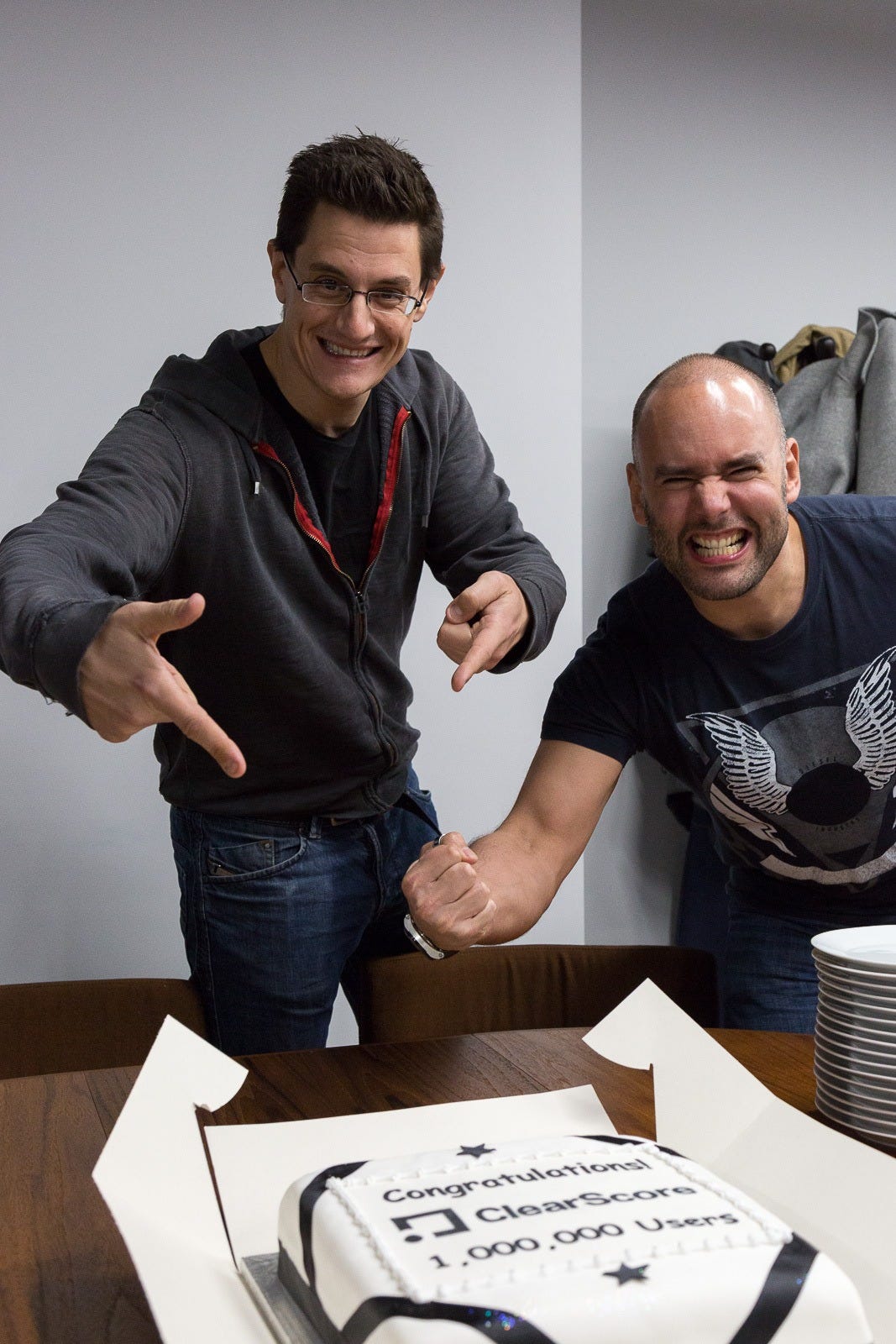
Memories of that time are illustrative of the chaos and excitement of being part of something growing so fast. In the business’s first office, a one-room in Hammersmith, Basini remembers getting everyone 80cm desks to fit everyone in. He also recalls how James Mantle – head of talent at ClearScore between 2016 and 2017 – would sit in a hallway, wired headphones plugged into his iPhone, talking to candidates, because there was no other space to take a call. According to Mantle’s LinkedIn, he was there for just under 18 months and oversaw more than 70 hires in that time.
“It comes along very, very rarely, and so that was an extraordinary experience,” Basini says of that time “It was super demanding, lots going on, but it was very exciting.”
Spades and foothills
Though the sector has had over ten years to mature, Basini says we are “still in the foothills” of what fintech can be.
Areas he thinks are still to be cracked include financial management – while lots of apps offer tools to help users with that, there still hasn’t been enough of a breakthrough on the consumer apathy point. Many people still just have a bank account and do very little with it.
Structurally, he sees more opportunities for open finance too. “If they want to open up SME lending in the UK, they should force HMRC to do an open banking-style access to all of the data that they hold. Vat receipts. Tax returns, etc.” There is some work happening on this in the ideas being trialled by the Centre for Finance, Innovation and Technology (CFIT), but there is still much more that could be enabled.
As for the AI sector, Basini – ever the product guy – sees the next crop of exciting companies being those that translate the technology into interesting applications. If you’re supposed to sell spades in a gold rush, “I don’t think the Spades are OpenAI or Anthropic”.
“I think the spades are the companies now that are going to build on top of these things to really allow amazing use cases to happen.”
Teatime scroll Each week I share links to writings, events, tweets and other conversation-starters. If you have something you think should be in here, feel free to email or DM me.
📙 I wrote a review of Sebastian Mallaby’s The Infinity Machine for Beauhurst Insights
💜 Orbital Industries has raised a $50m Series B round led by plural. The company, which uses AI to design advanced materials, was co-founded by former DeepMind research Jonathan Godwin.
🧢 A sign that the baseball cap bullrun is only just beginning? Branded gifting and merch platform Go Swag has raised $5m to expand its operations.
📲 German agentic customer support company Parloa has opened a London office and is hiring.
🎵 Really captured the 2010s startup vibes while writing this today by listening to some of my favourite work-friendly music: the score of WeCrashed.