
The productivity play
Cogna co-founder and CEO Ben Peters on productivity, hiring, and a potential push into the public sector

“There’s all this hype around AI taking jobs, and I think the reality is: most people don’t understand how complicated people’s jobs are.”
Ben Peters should know. It’s been his mission since 2023 to untangle some of the most complex systems of work imaginable: utilities, factories, facilities management, logistics. Cogna, which he co-founded after selling his previous startup to Bosch, builds custom AI software for critical workflows across those industries, working with customers like Ocado, Tropicana, and Cadent Gas.
His LinkedIn bio declares that Peters is “solving the productivity problem”. But in his view, that goal doesn’t necessarily mean replacing jobs.
“People are massively ambidextrous,” he says. Decisions are made by weighing up calculations of resources, constraints, opportunities and applying judgment. “It’s not like you can just open ChatGPT and it’s going to solve it for you.”
This week, Cogna published a report identifying “an enormous black hole of squandered resource at the centre of UK industry”. As part of research into whether AI can solve the UK’s productivity crisis, respondents reported losing at least 30% of their time each week to manual, low-value work. Meanwhile 70% of workers say they often have to wait for approvals to do their jobs, slowing down workflows. Skilled employees are “forced into the role of idle bystanders at work rather than active participants”.
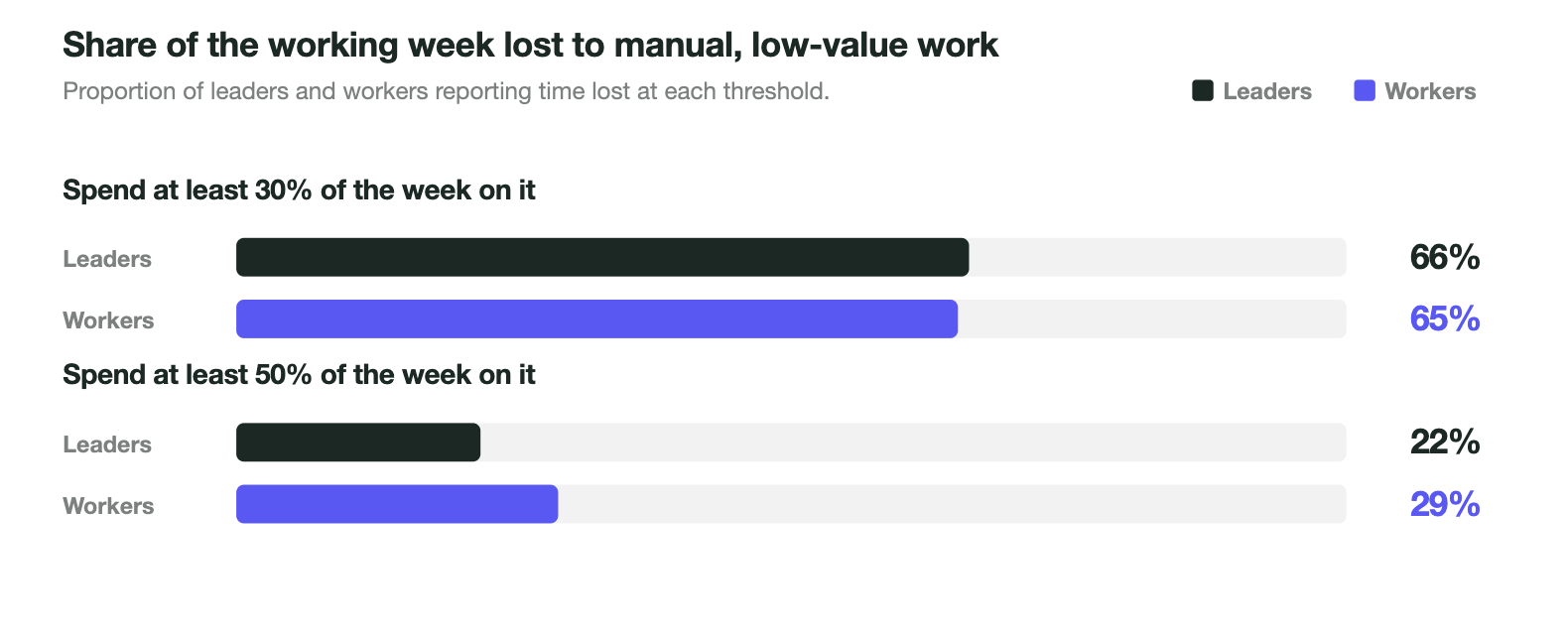
“We need technology that amplifies human ingenuity, rather than hindering it,” Peters writes.
Reducing this busywork and admin delay is part of what he says he’s trying to do with Cogna. Teams design applications that join up systems where companies have historically relied on manual coordination and other slow workflows, handling everything from gas escape management to blending fruit juice.
But he sees this as a bigger opportunity on an economic level. “There are three core ingredients to productivity – or more broadly growth on a macro level,” he tells me. “You’ve got labour costs, energy costs, and cost of capital. And the UK is not doing great on any of those, frankly.”
“The opportunity for us, in AI, is that it touches all three.”

Peters seems to care deeply about making things better, including making things better in Britain. But at the same time he is a realist, wary of puffing up the UK tech sector when it still faces many challenges. This all makes him a good interviewee: willing to weigh in on a range of subjects and speak plainly about them, a facet that is surprisingly rare in CEOs.
We first spoke almost exactly a year ago. It was during the previous London Tech Week, when Jensen Huang appeared on stage to admonish the UK’s lack of AI infrastructure. I was put in touch with Peters because he had a slightly different take: the UK was a “scrappy startup” nation and not a “heavy roller”. It could never be sovereign in the way the compute salesmen seemed to promise, and should instead bet on where it would see the best returns.
He feels similarly today, describing the conversation around sovereignty as “a bit of a confusion and distraction”, with a bit of “political posturing” thrown in. It’s not that there are no opportunities in infrastructure buildout, but that everything always comes back to energy. He suggests having a national mission, an “energy, energy, energy” successor to Tony Blair’s “education, education, education”. If energy costs can be addressed, then the other pieces will follow.
With its main office in London, Cogna now has about 80 employees, having recently been on a hiring tear. Peters estimates that half his time is just spent hiring. In the last couple of months alone, the business has announced the appointment of a new manager for strategic industries, a new chief of staff, and a new CTO. Being flexible about hiring across locations – including the Bay Area, Seattle, and Zurich – has allowed the company to scoop up some great talent, Peters says, though he’s also pleased that there’s so much here in the UK.

“All this talent is aggregating in London. We’ve got to use that as an opportunity to peel some of it off into actually British companies that are going to work for British industry.”
He isn’t too worried about the big AI labs making it harder to hire by driving up salary, though. “Even though you’ve got more businesses paying huge salaries, you can still find people that are more mission-driven than purely cash-driven.”
Indeed, this is part of the pitch when hiring. “It’s a huge part of why people join us, is the mission. To have that impact.” There’s the chance to improve productivity in critical industries like gas and water, but he also teases that in the future there could also be something built more directly for the public good.
It isn’t something the business would do right now because public sector procurement cycles are too long (that’s another thing he thinks there needs to be a national imperative around fixing), but as it gets bigger “we will definitely be building our public sector-facing business”. He won’t say much beyond that, other than that this has been part of the plan since day one.
“There’s just so much to be done there, there’s so much impact you can have. I feel like that’s a target-rich space for us.”
This pull towards purpose-driven businesses folds into that palpable strain of tech culture at the moment that calls on its citizens to do things that matter – an explicit contrast to the companies engaged in what Jasmine Sun calls “vice signalling”, or the “grindslop” identified by Will Manidis.
I ask Peters if he’s noticed an uptick in people who want to do something meaningful, especially the kinds of people in the UK who want to use their talents to help fix the failings of government and public services. Is it an upswell of altruism? The vibecoding revolution? A Dominic Cummings effect?
It’s always been there, he says, but he agrees it’s more noticeable recently. His diagnosis of why is a little starker than mine.
“Smart people can see that we’re fucked.”
And as highly qualified technical people do, they start to think about ways to fix it.
Teatime scroll Each week I share links to writings, events, tweets and other conversation-starters. If you have something you think should be in here, feel free to email or DM me.
🚘 Wayve is considering selling a stake on the UK’s new private market, Bloomberg reports. If it goes ahead, this would give the fledgling Pisces system a good test drive.
✍️ We are already very oversubscribed for next week’s first event for the Founder-Writer Collective, but you can subscribe to the Luma calendar for updates on our future plans.
🇪🇺 The grim outlook of Europe 2031, a new thesis about what happens if Europe misses the boat on AI, has generated a lot of discussion on my timeline. I’m interested in the ambiguous position the UK plays in the scenario – pulling ahead due to the strength of its AI scene, institutions like AISI, and independence from the EU, but still beholden to the major powers. The report’s authors argue that the UK should be part of a middle-powers coalition to keep some leverage over the AI supply chain.
📊 Michael P. Gibson (co-founder of the Thiel Fellowship) argues in The Spectator that swathes of Westminster have succumbed to Palantir Derangement Syndrome. Thoughts?
🏁 Messaging app Signal is pushing back on the UK government’s attempts to clamp down on children seeing nudity, which the company says amounts to “invisible surveillance infrastructure”. CEO Meredith Whittaker says the company may even pull services from the UK.
👍 Julia Willemyns wrote a thoughtful meditation on what the currency of likability might look like in a post-abundance world.
🎙️ “My bet is that widespread recording simply happens, because it’s too hard to stop, and the controls get retrofitted on top.” A16z GP David Haber writes about how one of the biggest taboos of the workplace evaporated.
💰 I was at Stripe Tour on Wednesday to see the fireside with Cleo founder Barney Hussey-Yeo. Between discussing his poker-playing AI agent and pricing psychology, he spoke about how the UK still isn’t taking enough risks. I did a quick write-up of those points on my LinkedIn page and the full interview with John Collison is here.
🍻 If you’re looking for something to do tonight, there’s a SoTA pub meet-up.