
Welcome to Bootstrap HQ
The dream of co-working is alive in Dalston

Just as demo day was about to start at Ramen Space, a passer-by knocked on the glass door. They wanted to know if they could get noodles there.
“Sorry just co-working, no ramen,” one member had to tell them. This apparently is not the first time this has happened.
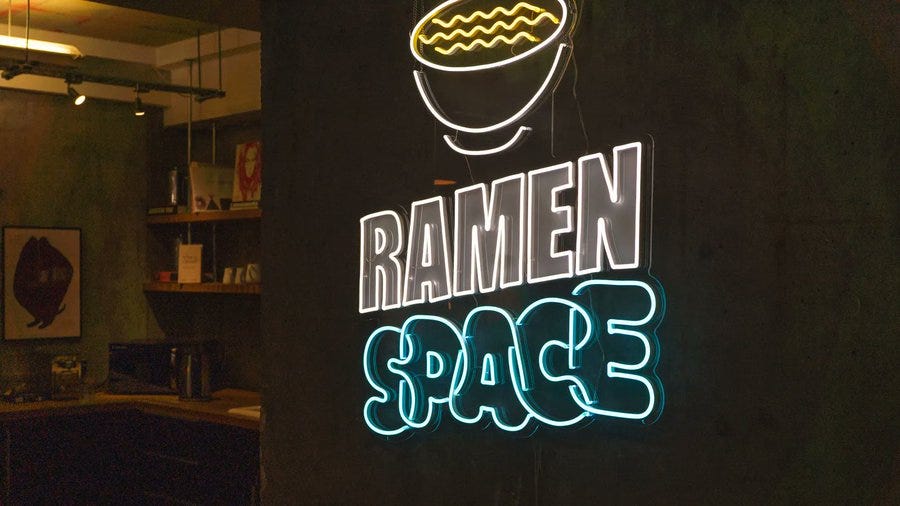
And who can blame them? The minimalist ground floor unit does look pretty inviting. Situated on a small square in Dalston, it has a stripped-back mix of plain grey walls, wooden tables and a neon ramen sign. It could easily pass for a hidden culinary gem of East London.
Instead, Ramen Space is a co-working space for founders. While the physical place is relatively new, it’s the culmination of years of community-building on the part of founder Charlie Ward.
With a background in creative agencies and later product management, Charlie has been organising get-togethers for people interested in independent tech businesses since the late 2010s. “I’ve always had a passion for like, building products and meeting people and working with people. So this is something that feels very natural to me to do,” he tells me.
Drinks evolved into weekend co-working sessions. Then the pandemic hit and instead of fizzling out, the group continued online in the form of Ramen Club, a remote work community on Slack. But there was always demand for in-person events and for hacking, debugging, marketing, designing and shipping side by side with other people working on similar challenges.
Once restrictions allowed, Ramen Club continued to host meetups. Then, as of about two months ago, it gained a permanent home at the co-working space in Dalston. I wanted to check it out, so I asked Charlie if I could sit in for a day.
I arrived early yesterday to get my pick of the 20+ desks. The room quickly filled up ahead of 10.45am, when we had a standup and shared a bit about ourselves and what we were working on. Most members are solo founders or members of small teams building SaaS products, sometimes working on a couple of projects at once.
After the standup, we headed en masse to Dusty Knuckle, a legendary local bakery, to grab coffee and pastries. It was the kind of sunny day in London that makes you really value the capital and what it has to offer. On the way there, I chatted to a couple of my fellow co-workers about the pros and cons of being an independent business builder in London: high living costs, yes, but access to hubs and meetups like these, good public transport and the advantage of safety nets like the NHS.
Back at our desks, it was time to work until lunchtime, when we all ate together around a big table. Then a few more hours of grinding, with the option to post in the #shipped channel on Slack any time you got something live. At 4pm it was time for demo day, which happens roughly once a month and has a hybrid format, with other Ramen Club members joining remotely via Zoom.
First up was Elston Baretto, founder of Tiiny Host, a tool for quickly deploying a mini website so users can share their work online. He had been adding new features including a way to share pitch decks with custom links and track how many people have opened them, as well as a Github integration.
Then Mike Adams took the floor to talk us through IntroStars, a platform for high-value introductions. People looking for connections post callouts promising the introducer a fee – usually a percentage of any resulting deal – if they link them up with the right person. I was intrigued by the idea of “super-connectors”, people with extensive professional networks, being able to make a side hustle out of introductions.
Finally, Andrew Cloke showed off the redesign of Data Fetcher. A no-code way to connect any API to Airtable, the business has been going for four years already with a plain white website and a Chrome extension. But Andrew explained that he wanted to improve SEO and conversions, and had smartened up the landing page with a pleasing lavender shade.
As each person presented, questions, feedback and kudos came in from other members. Unlike a big demo day with a stage and audience, there was a sense that this is a work-in-progress showcase. Products that are up and running and working, but can still iterate and adjust.
While people working on all kinds of different ideas come to Ramen Space, Charlie explains that there is a focus on entrepreneurs getting tools off the ground and building them from scratch with little or no funding.
“People don't realise that there’s actually a really big bootstrapping scene in London,” he explains. While a lot of attention is paid to who’s raising VC money, countless founders are plugging away at tools like these, growing them into steady businesses. “There’s, like, tons of people who are just killing it.”
That’s also where the name comes from. For anyone unfamiliar, ramen profitability is when a startup becomes profitable enough to pay the founder’s living expenses – even if they do need to keep those expenses low, hence subsisting on instant ramen. Or in this case, Dusty Knuckle breakfast buns.
The day finished off with a games night, drinks and pizza. An outrageously cute dog called Ted arrived. And I participated in a game of Poetry for Neanderthals, in which I had to describe the phrase “stock market” to my team using only one syllable words: your app go big, you go here.
Charlie tells me that, in the past, he’s sometimes encountered an attitude that is sceptical about the importance of an in-person side to this kind of community. “They were sometimes sort of like, there's no measurable outcome of doing in person events,” he says. “But I know that really meaningful stuff happens. It’s just hard to measure.”
It’s true that there’s no official ROI on IRL. But the fact London can be host to gatherings like these? That’s priceless.
Teatime scroll Each week I share links to writings, events, tweets and other conversation-starters. If you have something you think should be in here, feel free to email or DM me.
📗 Congratulations to Re:State, the think tank formerly known as Reform, on its new name. To celebrate the rebrand, the team there has released this free-to-read collection of essays on remaking the state, featuring contributions from Rachel Wolf, Michael Gove, Claire Coutinho and Andy Burnham.
☀️ London-based Rivan, which develops modular synthetic fuel plants powered by off-grid solar energy, has just raised £10m.
(As this post is from the archives, I have removed links to events that have already happened)