


This post is a collaboration with Eleanor Warnock. We’ve been running a series of in-person events in London as the Founder-Writer Collective since June, and this is a report from our latest, and spiciest, event yet.
Some debates about AI are about timelines and exponentials, others about legality and power. In the end, this one was about us.
Perhaps that was inevitable. As entrepreneur Bruno Marnette said in his closing speech, “I think every Oxford Union-style debate eventually digresses to human nature”. Whether or not that’s the case, the discussion challenged each of us to think about how we’re using AI, and what we do or don’t want from it.
It was a Thursday night in Shoreditch, and we had a queue out of the door for our latest and biggest Founder-writer Collective event. Inside the offices of Granola, everything was set up for a debate, with two sides lined up against each other and an audience open to changing their minds. The motion? This house believes that AI is making us less creative.
We began by taking the temperature in the room, which revealed an almost even split of 53% in favour and 47% against. And so the speakers set out to change minds.
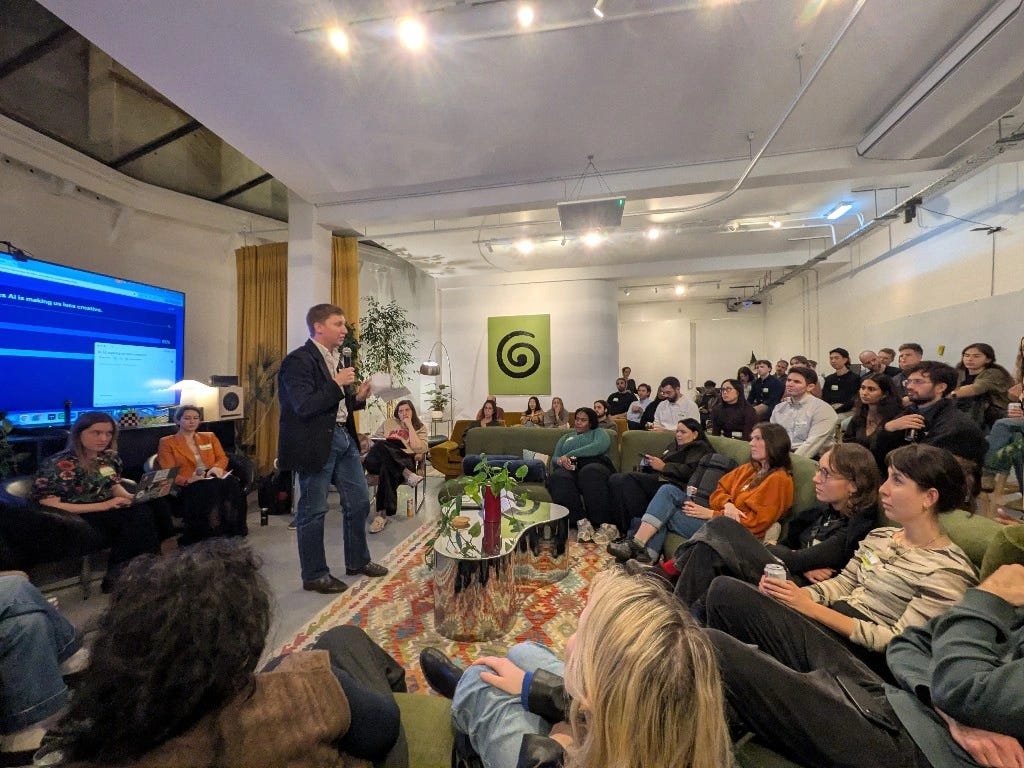
On the proposition side, cheerfully accepting the nickname of Team Luddite, was sociologist and communicator Paloma Ruiz and The Economist’s acting economics editor Archie Hall.
Archie started us off with a classic debating tactic of addressing what the other side might say before they’ve said it, to take the wind out of their sails.
“There are people who said photography destroyed creativity, even people who said woodcuts destroyed creativity, and they were probably wrong,” he acknowledged. But: “This time is different.”
Something that the proposition would repeatedly come back to was the effect of using AI on the human brain — as well as something less tangible that happens inside the brain, that we might call imagination or inspiration.
“The concept I find myself returning to a lot as I think about this, is the notion of cognitive surrender,” Archie explained.
He cited new Anthropic research published last week, which found that even expert analysts can be swayed by an agent’s take; it suggests even those of us who know our vocation well might be tempted to increasingly yield more of the process to AI.
It was this subtle handing over of responsibility, done almost unknowingly by AI users, that Archie warned the room against. And he had a particularly stark pronouncement for us writers in the room.
“There is a sense in which LLMs are kind of the ultimate ‘death of the author’ technology.”

We chose this format — often known as Oxford-style, but familiar also to anyone who has done competitive debating at school or university, and with many similarities to parliamentary debate — because we were a little bit bored of panels where nobody disagrees.
Yet there’s plenty to disagree about, even within the narrow slice of tech workers, media types and Luma addicts who come to events like these. At our previous Founder-Writer Collective meetups, we’ve found that people are weighing exactly these questions. How much should I let AI use into my writing process? Does it make me less of a writer? Does it matter if readers already enjoy AI-generated texts?
It can be a little bit taboo, in the age of Pangram plug-ins, to admit among fellow writers to any kind of LLM-dabbling. And it can make one seem like a naif, among fellow techies, to express worries about using the tools. Yet we’ll never arrive at any important answers if we’re not able to have honest conversations about these things.
The advantage of a debate is that it creates a space that is explicitly for disagreement; it acknowledges that different opinions to co-exist. And something notable at Thursday’s event was how good-humoured everybody was. If the proposition was to be known as Team Luddite, then the opposition were also happy to take on the mantle of Team Slop.
On that side of the room we had Marzia Niccolai, who spent 19 years at Google building products and now works on continuous learning AI at Fractal Brain. Alongside her was Bruno Marnette who runs the Taste Bench Project, an independent research initiative focused on understanding, measuring and improving taste-adjacent capabilities of AI. He’s also been a leader on technical teams at Meta and Palantir.
But it was Bruno’s previous experience as a founder of an AI-assisted tool for writers that he drew on for his opening speech. For that project, he interviewed 100 Substack writers to find out about their process.

“It would have been easy to assume these people are — what is the word? — in denial. In practice: people know. People know the traps. They learn them very quickly and they avoid them.”
Instead of denying the shortcomings of AI as a creative tool, Bruno took an optimistic stance on the way people will use it. Professionals who already know their craft will be able to suss out where AI is helpful and where it’s not. And as for hobbyists, he said, AI is in fact democratising creativity.
Image generation, for example, can be done in a few minutes on Midjourney rather than hours of learning Photoshop. Hollywood movies can be made on a $100 budget.
“My core point would be that millions of people, if not billions, are now re-experiencing the joy of creation. And I think in my book that’s a win, even if not always a masterpiece.”
When it was Paloma’s turn to speak in favour of the motion, she asked us all to close our eyes and remember the last time we had a good idea, and what we were doing at the time. Running? Commuting? Talking to friends? Showering? “I am almost sure you were not interacting with AI.”
Three components of creativity make it incompatible with AI, she argued. The first is boredom. Neuroscientists, she said, have identified daydreaming as something that blooms into the space that boredom leaves, and that AI is killing that opportunity.
The second is motivation. For this she cited Harvard professor Teresa Amabile’s work on the science of motivation, which finds that it is bound up with creativity and passion for one’s work. This pushes one not just to start a creative endeavour, but to push through setbacks.
The third is a more philosophical question about why we bother to create at all. For this, Paloma called upon the theories of Otto Rank, who suggested humans create in reaction to uncertainty. But when we reach for a generative tool, that is undermined. “AI is giving us certainty — fake certainty.”
To wrap up the opening speeches, Marzia also turned to audience participation. She asked everyone to vote on whether humans are more creative today or during the renaissance.
“Anyone who voted for the Renaissance is letting nostalgia get the better of them,” she said, pointing out that the vast majority of people, especially women, weren’t given the time and resources to be creative in the past. It’s technological progress that has slowly given more people the time to create.
AI fits that description in more ways than one. Moving beyond mere productivity gains, Marzia argued AI could give us more time without sickness or even extend our lifespans.
Then there’s the possibility of the emergence of new kinds of intelligence and understanding — not just for machines. Marzia, for one, is just waiting for the day she can talk to whales.
One reason we wanted to host a debate was to have floor speeches. Often at our events, the people in the audience are just as interesting as the speakers, and while there’s always the opportunity to ask a question, it’s often not quite enough. A floor speech is an impromptu contribution that anyone in the audience can make during the open portion of the debate, and there were some banging additions on Thursday — even though we limited each one to just 60 seconds.
Those opposing the motion included a Claude ambassador who talked about the social aspects of the AI community, noting that the tech has brought more interesting people into her life. One speaker pointed out that all kinds of things have previously been accused of reducing our creativity, including magazines and books and even coffee. Yet humans always found a way to keep creating.
On the other side was a student who worried that cognitive surrender could even extend as far as affecting our brain cell development. Another debater looked to some worrying trends in our preoccupation with productivity. “AI has made us believe that we cannot write an email that is two lines long.” If that is the baseline, how does anyone sustain the motivation to write a novel?
We finished up with closing speeches from each side, and then a second vote.
But in a twist we hadn’t foreseen, the proportion was exactly the same: 53% for, 47% against. Even though slightly more people voted. Speaking to attendees afterwards, it became clear that this proportion didn’t at all represent how willing people had been to change their minds. Several had changed sides, or gone from abstaining to voting or the other way around.
So while we didn’t end up with a clear winner in terms of who shifted the most votes, hopefully we proved something else. That ideas are dynamic, and that they are worth airing in good faith to those with whom you disagree, and to those who haven’t yet made up their minds.
When we first announced this debate, a couple of people asked whether London’s tech scene really needs debate. There’s this idea that Britain is too ready to tear down ideas where San Francisco is a frictionless launchpad of optimism. Leaving aside that SF already has its own debating society, optimism doesn’t necessarily mean agreement. To be confident enough in your own convictions that you’re happy to defend them, to be open-minded, to maybe even concede your opponents’ best points? That’s a strength that goes well beyond blind faith.
Teatime scroll Each edition I share links to writings, events, tweets and other conversation-starters. If you have something you think should be in here, feel free to email or DM me.
🥣 Thanks to Granola for hosting us. In a traditional debate, one person might typically take the minutes of what was said. In keeping with our venue, we took notes on Granola, and you can explore the full notes here.
📄 You can also read several other people’s takes on the debate on LinkedIn, courtesy of Dan Nash, Javiera Rubio, Alexandra Rybakova, Fiona Batchelor, Vincenzo Rampulla, Fernanda Grace Lins, Kashif Nazir, Tom Peters, and Lizzie Bielicki.
🎙️ I (Alys) was on the new Prospect podcast Tell Me Why discussing some of these exact issues a few weeks ago.
*️⃣ In Development and Asterisk are running an essay contest on how transformative AI will affect low- and middle-income countries, and how they might respond.